Anxiety therapy in Rochester, Michigan, can be more effective when you understand what you need before getting started. Asking the right questions helps you clarify your experience, expectations, and what kind of support will work best for you.
Taking time to consider these factors can improve how therapy works for you.
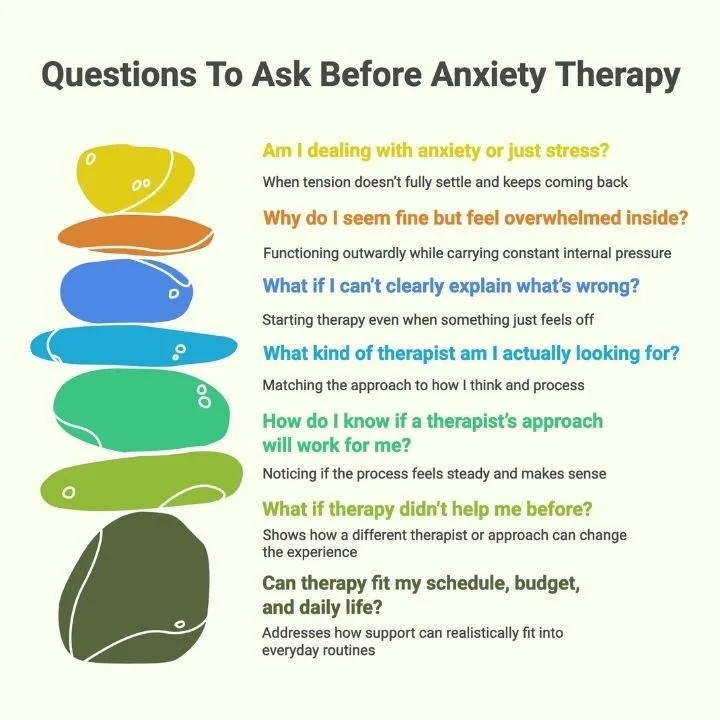
These seven questions can help you approach therapy as you begin, along with answers that can guide you.
1. Am I anxious enough for therapy, or just stressed?

You do not need to reach a certain level of distress for therapy to be helpful.
Stress and anxiety often overlap, but anxiety tends to stay present even when situations change. If your mind continues to race, or tension does not fully settle, it may be a sign that support could help.
2. Why do I look fine but feel overwhelmed all the time?

It is common to appear functional while feeling overwhelmed internally.
You may continue working, socializing, and managing responsibilities while carrying a constant sense of pressure. This disconnect can make anxiety harder to recognize, even when it is affecting your daily life.
3. What if I can’t explain what is wrong clearly?

You do not need to have the right words to begin therapy. Anxiety does not always show up as a clear problem. It can feel like something is off, even if you cannot point to one reason.
A therapist helps you talk through what is coming up, so things begin to make more sense as you go.
4. What kind of anxiety therapist am I actually looking for in Rochester?

The right therapist is one whose clinical approach aligns with how you process thoughts, emotions, and behavioral patterns.
Some therapists use structured, evidence-based methods such as Cognitive Behavioral Therapy to address specific thinking patterns and behaviors.
Others focus on identifying underlying patterns and emotional responses that influence how anxiety develops. Choosing an approach that fits your needs can support more consistent progress.
5. How do I know if a therapist’s approach will work for me?

A therapist’s approach tends to work when it feels consistent and aligned with how you think and respond.
It can help to ask what sessions usually involve and how change is noticed. This can give you a clearer picture of how the process may feel as it moves forward.
6. What if therapy didn’t help me before?

Previous therapy that did not help does not mean therapy cannot work. Different therapists use different approaches, and the connection between you and the therapist plays a large role. A different fit can change how the process feels and how helpful it becomes.
7. Can anxiety therapy in Rochester fit my schedule, budget, and real life?
Anxiety therapy can fit into daily life when it feels manageable and consistent.
Many therapists in Rochester, Michigan, offer weekly or biweekly sessions, typically lasting 45 to 60 minutes. Finding a rhythm that fits your routine can make it easier to stay engaged and continue the process.
Take the first step to prioritize your mental health
Prioritizing your mental health can begin with noticing what has been weighing on you and giving it space instead of pushing through it. Small shifts in attention can change how you respond to stress, helping things feel steadier and more manageable.
If you are considering anxiety therapy in Rochester, Michigan, this can be a starting point to move toward something different. When you feel ready, you can book now to begin the conversation.
Frequently asked questions
How can I tell if anxiety is more than everyday stress?
Anxiety goes beyond everyday stress when it stays present even after the situation has passed. You may notice ongoing tension, racing thoughts, or difficulty relaxing even during moments that should feel calm.
What does anxiety look like when it starts affecting daily life?
Anxiety affects daily life when it begins to interfere with focus, sleep, or decision-making. Tasks may feel harder to complete, and you may find yourself avoiding situations or feeling constantly on edge.
What kind of therapist should I look for for anxiety?
Look for a therapist who has experience working with anxiety and can explain how they approach treatment. A clear approach and a comfortable connection can make it easier to stay engaged in the process.
What types of therapy are commonly used for anxiety?
Common therapies for anxiety include Cognitive Behavioral Therapy, which focuses on changing thought patterns, and approaches that focus on emotional awareness and response patterns. Each approach works differently depending on how you process situations.
What red flags should I watch for when choosing an anxiety therapist in Rochester, Michigan?
Red flags include unclear communication, lack of structure in sessions, or feeling consistently misunderstood. If the process feels confusing or disconnected after a few sessions, it may not be the right fit.